Gina Isbell
Five Days at MemorialGina Isbell is the LifeCare nursing director whose work during Hurricane Katrina moved from preparing critically ill patients for a storm to caring for them amid Memorial Medical Center’s failing systems and delayed evacuation. She helped direct the transfer of patients from LifeCare’s vulnerable Chalmette campus, coordinated care on Memorial’s seventh floor and at its evacuation staging areas, and continued to identify herself with the duty to remain and help. The deaths and near-abandonment she witnessed left her changed, but did not diminish her conviction that she and her colleagues had done what they could.
Identity and Professional Background
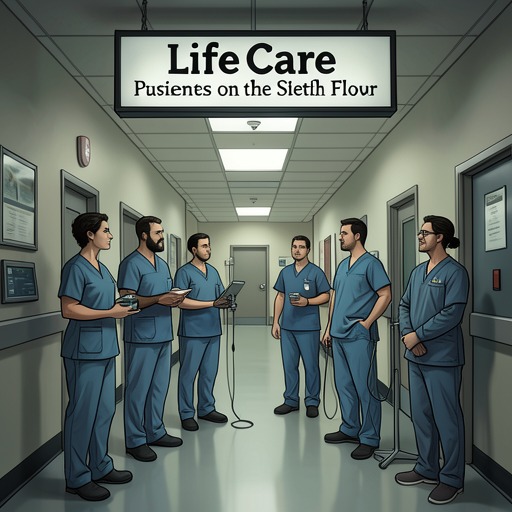
Isbell was a forty-year-old registered nurse when the storm approached. Her home, family, and hospital were all in St. Bernard Parish. She led nursing at LifeCare, a specialized hospital in Chalmette on Virtue Street, where many patients were seriously ill and dependent on extensive care. The prospect of a direct hit made the facility’s location a pressing concern: if forecasts of catastrophic flooding proved accurate, water could rise above its single-story roof. Moving patients also carried risks, since a false alarm would mean transporting very sick people unnecessarily.
LifeCare was not a hospice. Its patients, many elderly or debilitated, often relied on mechanical ventilators while receiving long-term treatment and rehabilitation intended to help them breathe independently and return home or to nursing facilities. The institution had its own administrators, nurses, pharmacists, and supply chain, even where its operation intersected with other hospitals. LifeCare’s higher-floor campus at Memorial Medical Center offered a place to move patients from St. Bernard Parish; staff still called that location LifeCare Baptist, recalling its earlier institutional identity. Isbell’s role therefore involved both nursing judgment and the practical work of moving dependent patients into a building where they could be sheltered with other hospital operations.
The book also situates Isbell’s experience within a wider failure of evacuation capacity. New Orleans residents without cars faced a shortage of transport, while traffic immobilized people trying to leave and Acadian Ambulance dispatchers received more requests than the available vehicles could readily meet. These pressures formed the background to the decision to move LifeCare patients rather than assume that public rescue would be available in time.
Preparing for the Storm and Moving Patients
After receiving a worrying call from her boss, Isbell put on her nursing uniform and began preparing for the threatened hurricane. At the start of the season she had assigned nurses to an A team and a B team. She called the A team to work with her at the Memorial campus during the storm, with the B team expected to replace them after it passed. The nurses she selected were experienced, dependable colleagues who had volunteered, although they would be working in an unfamiliar hospital. Isbell’s preparations depended not only on moving patients but on assembling a team she trusted to function under pressure.
The transfer from Chalmette took until nightfall. Nineteen patients reached the Baptist campus at Memorial; a twentieth died during the journey. That loss marked the danger inherent in both choices: staying in a flood-exposed building threatened patients, but transportation itself could be fatal for someone already critically ill. Isbell had a particular commitment to patients whose complicated medical needs discouraged some health professionals, and the move placed many of those patients under her care in a new setting.
On Memorial’s seventh floor, LifeCare occupied the north, west, and south hallways, while the eastern corridor belonged to Memorial’s marketing department. Isbell moved repeatedly between rooms and nursing stations, checking that patients were registered and properly situated. Among them was ninety-year-old Alice Hutzler, whom Isbell knew from repeated stays and affectionately called Miss Alice. Hutzler had been moved into Room 7305, a spacious west-side room with two televisions, a clock, and three roommates, including Rose Savoie. Even amid the strain of relocation, Isbell saw Hutzler as lively and familiar. A call from Hutzler’s daughter reached the floor, but Isbell was too busy to answer it herself and sent a message instead—a small interruption that later sharpened her sense of personal responsibility toward the patient.
Care Amid the Evacuation Crisis
As Memorial’s situation worsened, the hospital’s command shifted toward urgent action before power failed. The general emergency atmosphere became increasingly military in character, but Isbell’s work remained rooted in the immediate needs of individual patients. During the evacuation, staff used flashlights to read charts and placed numbered triage sheets on patients’ clothing or gowns. Roughly three dozen patients classified as category one from Memorial and LifeCare were brought toward the emergency-room ramp, where airboats were beginning to carry people to dry ground. Isbell and Memorial nurse manager Karen Wynn took charge of the patients’ care while they waited.
The work was not limited to transport or advanced treatment. Isbell, Wynn, and other staff tried to meet patients’ basic needs for nutrition, hydration, and elimination, while medical care was largely unavailable. The strain could also appear in patients’ confusion and unsafe attempts to move. One woman, increasingly disoriented, tried repeatedly to send her sister’s wheelchair rolling down sloping pavement toward floodwater. Isbell ran after the patient to stop her; Wynn also intervened when the woman attempted to wander away with her sister’s medical chart. The episode conveys how evacuation work required constant attention to people whose illness and confusion made ordinary safeguards difficult to maintain.
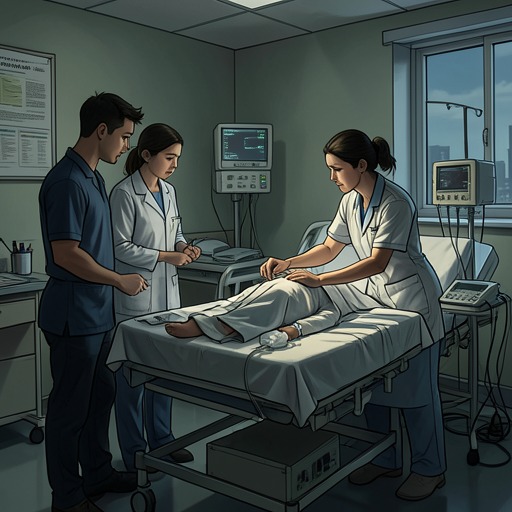
Isbell’s most intimate crisis came while caring for John Russell, an eighty-year-old LifeCare patient with cardiac disease who had been treated for a serious leg infection. After the backup power failed, he was found without breathing or a heartbeat. Staff resuscitated and intubated him, restored a livable heart rhythm, and carried him downstairs. Isbell stood beside his stretcher and squeezed a manual resuscitation bag to force air through his breathing tube. Hand ventilation was less precise than a machine, and the effort was physically demanding. Russell twitched and remained largely unresponsive as the wait in the hot corridor approached an hour.
When the stretcher reached the machine room on the route to the heliport, a physician checked Russell’s eyes with a flashlight and told Isbell that he needed oxygen. Isbell believed the doctor who told her there was no more oxygen. She stopped ventilating Russell, embraced him, and stroked his hair as he died. The scene is not presented as a simple choice between care and indifference: it follows attempted resuscitation, prolonged manual ventilation, a wait for evacuation, and the reported absence of oxygen. Isbell then covered Russell’s face and rolled him out of the machine room. She sat beside his feet awaiting instructions from LifeCare nurse executive Therese Mendez about where to take his body. Requests from passersby for the gurney angered her because she felt Russell deserved respect even in a hospital where equipment and space were urgently needed.
After a brief return to the relative cool of her car with Mendez, Isbell went back to the seventh floor carrying Russell’s chart. She gave it to Roy Culotta, a pulmonary physician who had inherited Ewing Cook’s patients and had entrusted his own grandmother to LifeCare’s nurses during the storm. Isbell told Culotta that Russell had died on the second floor and had been moved to the chapel. Despite having worked through the night, she returned to the evacuation effort and went downstairs again to oversee patients being moved toward the ambulance ramp, where boats were expected to take them to dry ground.
Responsibility, Distress, and Aftermath
When Isbell returned to the seventh floor after a day and night working below, she found Alice Hutzler and Rose Savoie still in their shared room rather than in an evacuation line. Hutzler appeared dehydrated and barely responded. Isbell felt guilty because she had promised Hutzler’s daughter that she would take good care of her. The promise linked the nursing director’s large-scale responsibilities to one patient and one family; the crisis repeatedly made it impossible to treat those obligations as separate.
Later, Isbell encountered her friend and staff nurse Andre Gremillion leaving a meeting in tears. She took his arm, guided him into an empty room, and tried to comfort him. When she asked what had happened and he did not answer, she embraced him and reassured him that things would be all right. She then sought out LifeCare assistant administrator Diane Robichaux, asking what was happening and why no one was coming to help. Robichaux had no answer. LifeCare leaders split up and ordered nurses to leave immediately. Cindy Chatelain was told to abandon the medicines she was about to give Elaine Nelson and leave without transferring responsibility for the patients; Gremillion, who was caring for two patients, also asked whether someone would take over before he was told to evacuate.
Robichaux sent Isbell to the back staircase to prevent people from reentering the cleared floor. There Isbell sat alone, exhausted and upset, with a heat rash and aching skin wounds. She let some staff members through to retrieve belongings. She again thought about her promise to Hutzler’s daughter and feared that her patients might die before help arrived, though she could not accept that no one would come. The account holds together two aspects of her conduct: she carried out the instruction to secure the staircase, while remaining emotionally fixed on the patients whose care had been interrupted.
On October 18, after CNN’s reports had aired, Isbell met representatives of the attorney general at LifeCare’s Kenner hospital, near the New Orleans airport; a LifeCare attorney joined by telephone. She reacted angrily to the idea that a doctor who had tried to comfort patients should be treated as the central villain. In her view, the government had failed to arrive in time, and that delay had cost lives. She argued that responsibility should be directed toward the inadequate response rather than toward clinicians who stayed and worked through the storm. Her account placed Memorial’s ordeal in the scale of both war and a sinking ship, emphasizing the combination of danger, isolation, and failed rescue that shaped her understanding of what happened.
Memory and Narrative Significance
When the 2007 special grand jury declined to indict Anna Pou, some LifeCare nurses celebrated, feeling that the decision also lifted suspicion from those who had entrusted patients to her. A nursing-school friend called Isbell with the news while she was at work with another former LifeCare nurse; the two women screamed, shouted, and jumped up and down. The celebration did not erase Isbell’s grief or settle the broader questions raised by the disaster. She wore a hurricane-shaped pendant, continued to see her Katrina patients’ faces in nightmares, and remained angry—not at Pou, but at the thought that help had come too slowly. She described herself as permanently changed by the storm and by the way those days ended.
One memory offered her some comfort: during her final hours on Memorial’s helipad, Culotta’s eighty-seven-year-old grandmother had taken Isbell’s arm and credited her with helping the woman survive until the next day. Isbell held to the belief that she and her LifeCare and Memorial colleagues had done the best they could. She said she would serve again in a storm if asked, because the work was her job and her oath. Her character arc does not resolve the moral and institutional failures surrounding Memorial; instead, it shows how professional commitment endured alongside exhaustion, guilt, anger, and lasting trauma.